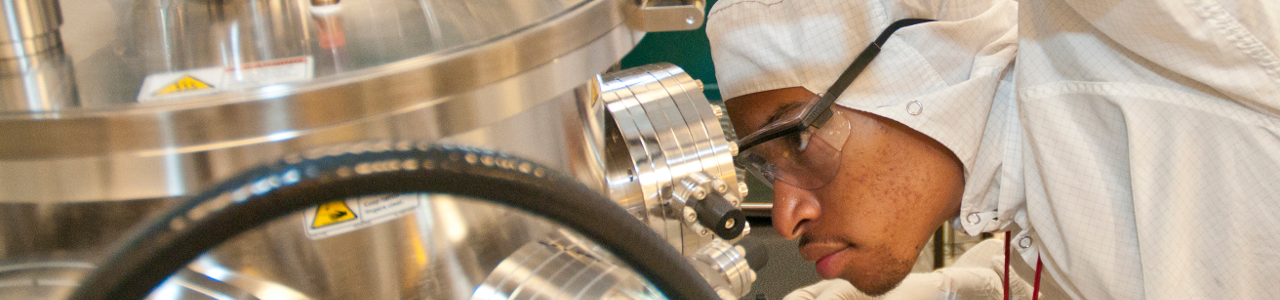
CNF has one of the largest and most advanced openly available suites of instrumentation for micro-and nanofabrication and characterization. CNF’s facilities are, for the most part, housed in its 15,000 sq.ft. clean room in Duffield Hall on the Cornell campus.
Generally our resources are organized in the following categories. Many systems have materials restrictions and process restrictions.
Biotechnology
Fluidic Probe Station
The Corsolutions Fluidic probe station is for quick testing of microfluidic devices. It features special fluid probes for contacting the device and precision pumps with integrated flow meters for measuring flow.
Malvern Nano ZS Zetasizer
The Zetasizer characterizes nanomaterials in a solution. It uses Dynamic Light Scattering to determine the polydispersity of a sample and measure particle charge and size.
Malvern NS300 NanoSight
The NanoSight uses the technology of Nanoparticle Tracking Analysis (NTA) to characterize nanoparticles from 30 to 800 nanometers in liquid.
Chemical Vapor Deposition and Hot Processes
Atmospheric General Material Anneal Furnace
Anneal furnace for category 5 samples. Nitrogen and Argon inert gas ambients, Wet and Dry oxidation processes. Can process pieces, 100mm and 150mm wafers.
Atmospheric POCL3 Doping Furnace
POCl3 doping furnace for N+ Phosphorus doping on silicon compatible materials. Pieces, 100mm and 150mm substrates.
LPCVD Silicon Nitride Furnace for III-V substrates
LPCVD furnace for depositing silicon nitride on Category 3/III-V substrates. Capable of deposition on pieces, 100mm and 150mm substrates
LPCVD Silicon Carbide
LPCVD Silicon Carbide furnace capably of depositing undoped and doped (nitrogen) poly-crystaline silicon carbide films. Depostion temperatures range from 800 to 900 C.
Atmospheric Silicon Anneal Furnace
Anneal furnace for silicon based substrate materials. 1100 C max temperature, N2, Ar, 5%H2/N2, 5%H2/Ar , and dry oxidation processes. Pieces, 100mm and 150mm substrates.
Atmospheric High Temperature Wet Oxidation
Wet and dry oxidation for silicon based substrates up to 1200 C. Pieces, 100mm and 150mm wafers can be processed.
LPCVD LTO
LPCVD Low Temperature Oxide using SiH4 and O2. Deposition temperature of 450 C, 100mm and 150mm wafers.
LPCVD Silicon Nitride
LPCVD Silicon Nitride for depositon on silicon based substrates. Deposition of Silicon Nitride, Low Stress Silicon Nitride, High Temperature Oxide and Oxynitride films. Depositon on pieces, 100mm and 150mm wafers.
Atmospheric MOS Metal Anneal Furnace
Atmospheric anneal furnace for category 2 MOS metal samples. Nitrogen, Argon, H2/N2 or H2/Ar 5% forming gas, and Dry Oxidation are available gas ambients. 1100 C max temperature, pieces, 100mm and 150 mm substrates.
LPCVD N+/P+ Polysilicon Furnace
LPCVD Polysilicon furnace capable of undoped, N+/Phosphorus, P+/Boron in-situ doped films. 100mm and 150mm compatible
Solid Source Boron Doping Furnace
Boron Doping furnace set up with 100mm planer diffusion sources. Can be equipped with 150mm sources if needed.
Solid Source Phosphorus Doping Furnace
Phosphorus Doping furnace set up with 100mm planer diffusion sources. Can be equipped with 150mm sources if needed.
LPCVD N+ Polysilicon Furnace
LPCVD Polysilicon furnace capable of undoped and N+/Phosphorus in-situ doped films deposited on CMOS compatible silicon based substrates. 100mm and 150mm compatible
LPCVD P+ Polysilicon Furnace
LPCVD Polysilicon furnace capable of undoped and P+/Boron in-situ doped films deposited on CMOS compatible silicon based substrates. 100mm and 150mm compatible
Atmospheric Gate Oxide Furnace
Dry oxidation for CMOS compatible silicon based substrates. 1100 C max temperature, O2, HCL and N2O oxidations
Atmospheric Wet Oxidation Furnace
CMOS compatible wet oxidation for silicon based substrates. 1100 C maximum temperature.
LPCVD Undoped Polysilicon Furnace
LPCVD Polysilicon furnace capable of undoped films deposited on CMOS compatible silicon based substrates. 100mm and 150mm compatible
LPCVD CMOS Silicon Nitride
LPCVD Silicon Nitride for depositon on silicon based CMOS compatible substrates. Deposition of Silicon Nitride, Low Stress Silicon Nitride, High Temperature Oxide and Oxynitride films. Depositon on pieces, 100mm and 150mm wafers.
AG 610 Rapid Thermal Annealers
Rapid Thermal Annealers (AG Heatpulse 610) use high intensity, visible radiation to heat samples (up to 150mm) for short periods (1-600 seconds) at high temperatures (400-1150 C) in an annealing ambient of oxygen, argon, nitrogen, or forming gas (5% H2 in Ar). Applications include ion implant activation, annealing, oxide reflow, silicide formation, contact alloying, and gallium arsenide processing.
Computation
Computational software tools play an important role at the CNF. With CAD and conversion software, users go from idea to design to device. In addition, design and process simulation codes allow users to correct for material or tool characteristics and to simulate portions of or entire process flows.
A subset of the below software tools are available remotely -- contact us to discuss your computational needs.
Software tools include:
- AFM NanoScope Analysis
- Ansys
- AutoDesk
- Cadence
- CompleteEASE
- CorelDRAW
- Coventor SEMulator3D
- DeScribe
- GenISys BEAMER
- GenISys LAB
- GenISys ProSEM
- GenISys TRACER
- KLayout
- L-Edit CAD Software
- LinkCAD pattern preparation software
- PROLITH by KLA-Tencor
Dry Etching
Dry Etching, known variously as plasma etching or reactive ion etching, uses a plasma to dissociate a generally non-reactive gas into a plasma of reactive radicals. Various gases and plasma configurations are used depending of the material and desired process results.
AJA Ion Mill
The AJA Ion Mill is a 22 cm diameter Kaufman RF-ICP gridded ion source producing a collimated Argon ion beam which provides uniform etching of samples up to 6 inch diameter. The sample holder is water cooled at 23 degrees C. and has motorized tilt (0-180 degrees), and continuous sample rotation up to 25 RPM. The system is Cryo Pumped with a base pressure in the 10-8 torr range. It is generally used for materials for which there is no appropriate chemical/plasma etch.
Anatech Resist Strip
The Anatech USA, model SCE-110-RF, Oxygen plasma Asher is a 10 inch diameter all quartz barrel asher. It is ICP powered 13.56 MHz up to 900 Watts. It is equipped for both oxygen and nitrogen plasma. It can process small pieces and up to 200 mm wafers.
Glen 1000 Resist Strip
The Glen 1000 system utilizes a oxygen plasma source for stripping of photoresist and other organics. The tool can be setup to give direct ion bombardment or in a downstream ion mode for lower surface damage. Nitrogen is also available.
Oxford 100 ICP
This ICP system is dedicated to silicon based dielectrics (SiO2, Si3N4, SiOxNy) and is uniquely equipped with a gas ring in addition to traditional shower head gas delivery of highly polymerizing fluorocarbon and hydrofluorocarbon gases. Gases include CF4, CHF3, C4F8, C4F6, CH2F2 as well as additives such as O2, Ar, He, and CO2. This system is mechanically clamped and can accommodate up to 100mm diameter wafers.
Oxford 80s
CNF has two Oxford 80 open load reactive ion etching systems configured with varous fluorocarbon gases, primarily for etching silicon based films.
Oxford Cobra ALE Quantum
Atomic Layer Etching (or ALE) is an advanced etch technique that allows for excellent depth control on shallow features. As device feature size reduces further and further ALE is required to achieve the accuracy required for peak performance. This tool is configured for etching materials used in quantum devices such as Niobium and Tantalum.
Oxford Cobra ICP Dielectric
This Oxford Cobra is an inductively coupled plasma based system that is configured for dielectric etching, primarily with Fluoropolymers. The system consists of one ICP process module connected to a single automated wafer transfer load lock. It is equipped with Helium backside cooling and a 10C electrode.
Oxford Cobra
This ICP system is configured with chlorine, bromine, and fluorine chemistry. This system is used to etch silicon and germanium photonics structures using HBr, magnetic tunnel junction (MTJ) layers using methanol (CH3OH) based chemistry, and silicon carbide with an SF6 based etch. Fluorine based metal etches such as tungsten are also included in this system. This system is mechanically clamped and can accommodate up to 100mm diameter wafers.
PlasmaTherm Versaline Deep Silicon Etcher
The Versaline DSE is an advanced deep Silicon etcher configured for fast switching Bosch processes. It can create high aspect ratio trenches and channels in Silicon wafers, or completely etch through Silicon wafers.
Plasma-Therm Singulator
Able to etch through Silicon wafers with photoresist mask all the way to the edge of the wafer. Works with chips or wafers up to 200mm.
Plasma-Therm Takachi ALE
Primaxx Vapor HF Etcher
This system is primarily used to isotropically etch silicon dioxide using anhydrous vapor HF. The VHF/alcohol process enables release of silicon MEMS structures without stiction. It is highly selective to silicon, alumina, aluminum, and silicon carbide.
Plasma Therm System 72
The Plasma Therm System 72 is open load reactive ion etching systems configured with various fluorocarbon gases, primarily for etching silicon based films.
Plasma Therm 720/740
This is a dual chamber RIE loadlocked system with both chlorine and fluorine based chemistry. The 740 (left chamber) has been designated a Au exposure system. It can be used to etch metals and dielectrics with either Au exposure or termination. The 720 (right chamber) is designated for chlorine and fluorine based etching of 2D materials such as MoS2, WSe2, NbSe2, AsSe2, and GaSe and perovskites such as SrRuOx, SrLaAlOx, and BaSrOx. Both chambers can accommodate up to 200mm diameter wafers.
Plasma Therm Dual Chamber 770
This is a dual chamber loadlocked ICP system with both chlorine and fluorine based chemistry. The left chamber is for chlorine based metal, metal oxide, and metal nitride etching including Cr, Ti, Al, Al-Si-Cu, Ta, Al2O3, Nb, TiN, TaN, AlN, piezo-AlN, and MoSi2. The right chamber is dedicated to III-V materials and includes gases such as Cl2, BCl3, CH4, H2, and SiCl4. Both chambers are mechanically clamped and can accommodate up to 100mm diameter wafers.
RAD-2500m/8 Wafer Mounter
Includes a RAD-2500m/8 Semi-Automatic Wafer Mounter for mounting 200mm, 150mm, 100mm wafers as well as pieces to dicing frames for etching in the Plasma-Therm Singulator, as well as a Semi Corp Model 365 UV Exposure System for releasing the wafer and frame from the tape after etching.
Samco UV/Ozone System
Utilizes UV light, heat, and Ozone for the removal of organic contamination as well as th e descumming, UV curing, and stripping of resist.
Trion Minilock III ICP Etcher
The Trion is a small load-locked ICP system with BCl3, Cl, CHF3, CF4, O2, N2, O2, and Ar f or etching a wide variety of materials.
PlasmaTherm Unaxis 770 Deep Silicon Etcher
The Unaxis 770 is a deep silicon etcher that utilizes the Bosch process as well as other unique processes developed at CNF.
Xactix XeF2
This system is primarily used to isotropically etch silicon, Ge, Mo and any materials that react spontaneously with atomic fluorine. One of its main purposes is to release MEMS structures by etching sacrificial materials without stiction. XeF2 is highly selective to silicon oxide, polymers, and most metals.
Xenon Difluoride SPTS
This is a XeF2 based vapor phase etch system for isotropic and selective silicon etching.
The primary application is for release of metal and dielectric structures by selective isotropic etching of silicon (ie, single crystal silicon, polysilicon, and amorphous silicon). This process can also be used to complement DRIE etching of silicon.
Y.E.S. Asher
Vacuum system with Oxygen Plasma, designed for Resist Stripping and Descum. It uses a 9" diameter Hot Plate stage to control wafer temperature. The system is used to strip resist off single wafers, up to 8" diameter. The 40 KHz plasma is isolated from the wafer by a grounded, perforated metal plate, making this a Down Stream system.
YES EcoClean Asher
The YES EcoClean is a single wafer, downstream ICP stripper designed for photoresist and polyimide strip, descum, and inorganic substrate cleaning/surface modification. The remote ICP source produces a high-density oxygen plasma and confines any charged plasma species to the plasma chamber such that only charge-neutral species flow from the source to the substrate. The tool can process silicon and gallium arsenide wafers of 2", 3", 4", 5", 6", and 8" diameter. Tool capabilities include 3,000 W RF power and hot plate temperature up to 300 C for fast resist removal.
Electrical Testing
Metrology equipment for electrically testing semiconductor devices
Everbeing 4-Point Probe
Everbeing Probe Station and Keithley 4200 SCS
Manual EB-6 probe station with Keithley 4200 SCS configured with 4 SMUs and a CVIV measurement card.
Filmetrics RS50 4 Point Probe System
Mapping 4 point Probe system. 1mohm/sq to 200 Mohm/sq sheet resistance. 200mm wafers capable.
HFTL DC Probe Station
This tool is configured around a Cascade Summit 12K probe station, including four Kelvin probes each mounted on a Cascade 208 or 210 probe positioner, an Agilent 4156C precision semiconductor parameter analyzer, an Agilent 4294A precision impedance analyzer, a Temptronic TPO3000 ThermoChuck system, a Kinetic Systems 1201 vibration-isolation table, and a personal computer running Keysight IC-CAP on Windows 10.
HFTL 50-GHz Small-Signal Probe Station
This tool is based on a Cascade Summit 9600 probe station on top of a Kinetic Systems 1201 vibration-isolation table. The probe station is equipped with two Cascade 103-754 x-y-z-θ probe positioners, a Mitutoyo 378-134-4 microscope (with long working distance and a built-in TV camera), and a 6"-diameter microchamber and thermal chuck (−50 to 200 °C). The thermal chuck is controlled by a Temptronic TPO3000 ThermoChuck system. The RF signal path consists of an Agilent E8364B vector network analyzer, two flexible 2.4-mm-diameter coaxial cables, two Agilent 11612V bias tees (capable of pulsed biases), two 2.4-mm semflexible cables, and two 2.4-mm probes, although 2.9-mm probes can also be used with 2.4mm-2.9mm adapters. The DC bias is supplied by an Agilent 4156C precision semiconductor parameter analyzer. Both DC and RF signals are controlled by a personal computer running Keysight IC-CAP on Windows 10.
HFTL Terahertz 4-Port Large-Signal Probe Station
A Cascade Summit 11K probe station with a 200-mm wafer chuck is available for Terahertz large-signal probing. The tool includes Anritsu MS4647B 4-Port 70kHz-70GHz VNA, two VDI 110-170 GHz frequency extenders, power meters covering DC to THz range, and GSG or GSGSG probes for on-wafer probing. The tool is capable of both small- and large-signal RF measurements up to 170 GHz and 17 dBm power.
HFTL Terahertz 4-Port Small-Signal Probe Station
The tool is based on an MPI TS2000-IFE 200-mm automated probe station with micron precision. In the standard configuration, the tool includes two RF probes of GSG, GSSG or GSGSG types, a microscope, a digital camera, and a thermal chuck with temperature control between -60°C and +200 °C. Other DC and RF probes may be added. The probes, the microscope, and the chuck are all automatically controlled in x, y, and z directions with optical feedback. The RF signal is provided by an Anritsu 4-Port ME7838G vector network analyzer capable of a single sweep from 70 kHz to Fig. 2. HFTL Terahertz small-signal 220 GHz. Up to 12 DC bias can be supplied by an Agilent 4156C probe station precision semiconductor parameter analyzer capable of +/-200 V, 0.5 A, and 100 V/us pulses, and two Agilent 6629A system DC power supplies capable of +50 V and 2 A. The tool is fully automated as controlled by MPI Sentio, MPI QAlibria, and Keysight IC-CAP software.
Xallent SAKYIWA NanoProber
Sheet resistance, resistivity, and IV-curve measurement tool compatible with up to 100mm wafers. By utilizing Xallent's fine pitch (10um) four point probes, it is capable of investigating how grain size/boundaries, defects, and material composition impact sheet resistance and resistivity.
Zyvex Nanoprobes
The Zyvex S-100 Nanoprobes are installed on the Zeiss Ultra-55 SEM and operate under vacuum during imaging or with the beam blanked. The S-100 consists of three individually controlled nanoprobes which can be placed with a precision of five nanometers. The probes have a minimum tip radius of fifty nanometers for precision measurements.
Electron Beam Lithography
Electron beam lithography (EBL) has long been established as the premier technique for defining structures at the nanoscale. Since it’s inception in 1979, the Cornell Nanoscale Science and Technology Facility (CNF) has remained at the forefront of nanofabrication research by providing state-of-the-art EBL tools to the academic and industrial user community. Although these tools can be used for mask fabrication, at CNF they are generally only used for direct-write applications
JEOL 6300 Electron Beam Lithography
The JBX 6300FS system is an advanced direct write ebeam lithography system for up to 150mm wafers. The unique capability of the JEOL 6300 is that a fifth lens can be used to get a smaller beam spot size and write sub-10 nm features.
JEOL JBX-9500FS EBL System
The JEOL JBX-9500FS Electron Beam Lithography System can load substrates ranging from 10 mm pieces up to 300 mm wafers and write features less than 10 nm in size. It has a 100 kV accelerating voltage, a 100 MHz clock and a 1 mm × 1 mm write field.
Nabity Nanometer Pattern Generator System (NPGS)
The Nabity system turns an SEM into a simple e beam lithography system. The pattern generator takes control of the deflection system on the SEM and can then be used to expose patterns in resist. This is particularly useful when there is a need for low energy exposures. The tool is very manual, as opposed to the fully automated JEOL systems.
Lithography Support
To support lithography operations, CNF has dozens of manual spinners, hot plates, and ovens, along with facilities for vapor priming, image reversal, resist development, and resist stripping.
Brewer Science 300 mm Hot Plate
Hot plate for heating 300 mm wafers, and also other large substrates such as large glass plates used for displays.
Brewer Science 300 mm Spinner
Spinner for applying resist on 300 mm wafers, and also on photomasks and large glass plates, such as substrates for displays.
Cee 1300X Hotplates
1300X hotplates are configured for proximity baking of resist and other films at various temperatures from 90C to 205C.
Cee Apogee Spinners (Class 1 Photolithography)
Cee manual resist spinners accommodate substrates from small pieces to 200mm wafers, with spin speeds over 6000 rpm and acceleration up to 30,000 rpm/sec.
Edge Bead Removal System
This Edge Bead Removal System uses a Brewer Science Cee Flange Spinner Model 200 platform along with a Nordson 752 Series Diaphragm Dispense Valve and their patented BackPack valve actuator controlled by their ValveMate 8000 Controller. The nozzle is mounted on a 4-axis cantilevered T-Slot arm with position micrometer on the X-axis for adjusting the bead size. It utilizes Microposit EBR 10A as a solvent.
SUSS Gamma
The Suss MicroTec Gamma Cluster Tool is an automated photoresist and wet processing system designed to meet needs for clean, reliable and high throughput photolithography processing. In addition to the manual facilities used for small lots, CNF has this advanced robotic coating/development system which can process cassettes of wafers up to 200 mm. It also incorporates the AltaSpray spray coating system for non-planar substrates.
Hamatech HMx900s
The Hamatechs are single wafer automated chemical processors. CNF has a total of six of these units, configured for various cleaning, stripping, and resist development processes.
YES Process Ovens
CNF has four Yield Engineering Systems ovens, a Vapor Priming vacuum oven, an Ammonia Image Reversal oven, a Polyimide Curing oven for 150mm wafers, and a second Polyimide oven for 200mm samples. All three systems allow fully programmed operation.
Miscellaneous and Back End Processing
Tousimis Critical Point Dryer
The Tousimis Critical Point Dryer is used to prevent surface tension while gently drying devices such as MEMS and Microfluidics to prevent stiction after a wet etch process. This tool can handle samples from small pieces up to 6" wafers.
Disco Dicing Saw
The Disco Dicing Saw can dice device sizes from small pieces up to 8" wafers. It can dice wafers on simple basic X Y axis or advanced settings for multiple angles. There are two standard blades that we use for dicing different types of substrates such as Silicon and many types of Glass. As well as some specialty blades for various other substrate.
Disco Wafer Grinder
The DA810 is a compact, automatic grinder for thinning of work pieces up to 8" in diameter. It has one spindle and one chuck table and is designed to process a variety of materials including Silicon, Glasses, Sapphire, Silicon Carbide and III-V's.
Electroplating Hood - Au
Gold electroplating hood
Electroplating Hood - Cu
Copper Electroplating Hood
Electroplating Hood - Ni
Tanks and solutions are available for electroplating on substrates up to 6 inch wafers. Applications include electroplating copper for damascene wiring, electroplating into resist molds to form high aspect ratio structures, and deposition of thicker films (> 5 µm) on substrates.
Finetech Fineplacer pico ma Manual Die Bonder
The FINEPLACER pico ma uses a precision optical system to align patterns on a small chip ( up to 20 x 20 mm) over patterns on a substrate (up to 100 x 100 mm, ). Alignment and placement accuracy is 5 microns. The two devices are then pressed together with a force, up to a maximum of 20 N (4.5 lb.). Temperature profiles (up to 450 deg. C) for the substrate support and for the chip holder are programmable for solder re-flow, or solder paste. A fiber optic UV source is also available for UV curing adhesives. A dispensing system is available for adhesives or solder pastes.
Logitech Orbis CMP (Chemical Mechanical Polishing)
The Logitech Orbis is a CMP tool capable of polishing 4 and 6 inch whole wafers. It can do automatic multistep polishing processes with diamond disk pad conditioning to maintain etch rates stability. The tool can be used for planarization or for damascene polishing of silicon oxide, silicon nitride, polysilicon, copper, tungsten, and other various metals.
MVD100
This tool is capable of depositing conformal monolayer coatings on a wide variety of substrates using a vapor phase process from liquid precursors.
ON NANO nanoBOND and nanoDEBOND System
The Bonding System nanoBOND 200 is intended exclusively for manual bonding individual wafers temporarily onto rigid carriers or other wafers.
The Debonding System nanoDEBOND 200 is intended exclusively to debond wafers, substrates or fragments from rigid carriers or other wafers under thermal influence.
Reynolds Tech Custom Plating Hood - Indium/SAC305
For electroplating of Indium and Silver/Tin/Antimony/Copper Solder Alloys. Open to substrates from pieces to 200mm wafers
2 electroplating cells with drag out tanks, non-contact wiper, static acid cleaning tank and cascade rinse tank
Suss SB8e Substrate Bonder
The Suss SB8e VAC substrate bonder is a universal tool for bonding proses for micro-electro-mechanical system applications such as Anodic Bonding, Silicon Fusion Bonding, Adhesive Bonding, and Thermal Compression Bonding. This tool can sustain wafers up-to 150mm. It can vacuum down to 5x10e-5 mbar with an overpressure up-to3 bar. The bonding process takes place in a controlled environment.
Versalaser Engraver/Cutter Tool
The Universal Laser Systems VersaLaser VLS3.50 is a CO2 laser that emits in the infrared spectrum to cut or etch patterns by vaporizing the substrate.
Westbond 7400A Wire Bonder
A wire bonder is used to connect the micron-scale pads of your device to the pads, or leads, in a package. This wedge-wedge ultrasonic type wire bonder (aka, wedge bonder) is currently being used with 1.25 mil aluminum wire. Minimum practical bond pad size is 100 microns square. It is now equiped with a Trinocular Stereo microscope, with TV camera, and viewing screen.
Other Lithography
Nanonex NX-2500
The NX-2500 is a multi-level nanoimprint machine with imprint capabilities in thermoplastic, photo-curable and embossing. This machine also eliminates relative lateral shifting between substrate and mold which affects mold lifetime. A very small thermal mass, ensure rapid and cooling, resulting in fast process cycles.
Photolithography
Photolithography (also known as Optical Lithography) is generally useful for features down to about a 0.25 micrometer lateral feature size. Light projected through a chrome mask is used to expose an area of light sensitive film (photoresist) on the substrate. CNF has both facilities for generation of the photomasks and photoexposure of wafers and substrates.
ABM Contact Aligner
The ABM High Resolution Mask Aligner is a very versatile instrument with interchangeable light sources which allow Near-UV (405-365 nm) as well as Mid-and Deep-UV (254 nm, 220 nm) exposures in proximity (non-contact) or contact (soft & hard) modes.
ASML PAS 5500/300C DUV Wafer Stepper
The ASML PAS 5500/300C DUV Wafer Stepper is our most advanced photolithography tool. It uses a KrF excimer laser to expose features smaller than 0.2 micrometers with layer-to-layer registration better than 45 nanometers. This projection printer uses a DUV (248nm) lens column (0.63 N.A.) to provide a 4:1 reduction with an exposure field size up to 22mm square.
C&D Automated Liftoff Tool
The C&D liftoff tool is an automatic high pressure solvent dispense tool for the purpose of metal liftoff using standard photolithographic materials. The tool handles 100 and 150mm wafers only. Recipes typically work by a pre-wet fan nozzle dispense step using PGMEA, then high pressure dispense of PGMEA at up to 2500psi, a final font and backside rinse with IPA then spin dry. Typically 4-10 minutes per wafer depending on the recipe chosen. LOR+positive tone resist bilayer strategies work well as do negative tone nLOF type resists. Some work has been done with MMA/PMMA combinations as well.
GCA 6300 DSW 5X g-line Wafer Stepper
The GCA 6300 DSW 5X g-line Wafer Stepper is a 5X reduction stepper using the mercury g-line (436 nm) with an ultimate resolution of 0.9 micrometers. It is generally used when depth of field is more important than resultion. This projection printer uses a lens column with 0.30 N.A. to provide a 5:1 reduction with a variable field size up to 15mm square.
GCA AutoStep 200 DSW i-line Wafer Stepper
The GCA AutoStep 200 DSW i-line Wafer Stepper is a 5X reduction wafer exposure tool designed for up to 200mm wafers. All operations are automated, including wafer loading (100mm wafers) and aligning, and reticle loading and aligning (5"). Resolution is better than 0.65um.
Heidelberg DWL 2000 Mask Writer
The DW2000 is an advanced laser writing system for mask fabrication. It can write mask features as small as 0.8 micrometers.
Heidelberg MLA 150 Maskless Aligner
The Heidelberg Instruments MLA 150 is a maskless aligner for direct-write lithography. Our machine is equipped with write mode I for feature sizes down to 0.6 micrometers and feature separation down to 0.8 micrometers. It has a gray scale exposure mode, both front and backside alignment capability, both 405 nm and 375 nm exposure wavelengths, field by field wafer mapping alignment, and many other capabilities. It accommodates substrates from 5 mm to 225 mm, with thicknesses up to 12mm. It performs all tasks of the DWL 66 it replaces, but faster and with better precision.
Alignment accuracy is 250 nm for local alignment, 500 nm for global alignment, and 1000 nm for backside alignment. The maximum writing speed is 285 mm²/min for both wavelengths.
Nanoscribe GT2
The Nanoscribe GT2 Laser Lithography System is a two-photon polymerization (2PP) volumetric printer. It can create three-dimensional nanostructures using a NIR femtosecond laser via direct-write onto a photosensitive resin that is subjected to a non-linear two-photon absorption process. This process involves cross-linking the resin via UV absorption. Designs are loaded as STL files, sliced by the DeScribe software and printed layer by layer with one of three objectives (10×, 25× and 63×), with better resolution at higher magnification (at the cost of lower speed) down to a minimum feature size of 0.2 μm.
Suss MA6 Contact Aligner 2
The MA6 is a workhorse contact lithography system (contact aligner) for 100 mm wafers. It can align to features on either the front or the back of the wafer using a video alignment system.
SUSS MA6-BA6 Contact Aligner
The MA6 is a workhorse contact lithography system (contact aligner) for up to 150 mm wafers. It can align to features on either the front or the back of the wafer using a video alignment system.
SUSS MJB4 Contact Aligner
The MJB4 contact aligner can be used for Topside Alignment and Backside Infrared Alignment on substrate sizes ranging 5mm square to 100mm in diameter. It is capable of printing 0.7um lines and spaces with a 365-436nm light source
YES PB8 Bake Oven
The YES PB8 450 is a high temperature vacuum oven using a programmable temperature controller and programmed vacuum and nitrogen flow cycles for curing of polyimide, SU8, BCB, and other films. The unit features filtered heated nitrogen purging the chamber in a laminar flow and acting to clean the wafers during the process.
Physical Vapor Deposition
PVD encompasses the vacuum thin film deposition techniques of evaporation and sputtering. CNF has systems that can deposit a wide range of materials.
AJA Orion Sputtering Systems
CNF has three AJA magnetron sputtering systems that can be used to deposit a variety of materials. The systems are load locked, allowing rapid sample exchange. Each system has five S-gun type sputtering sources. Both DC and RF magnetron sources are available.
AJA Quantum Materials Deposition System
The AJA Quantum Materials Deposition System is a multifunctional phyisical vapor deposition that is dedicated to quantum materials research activities. The tool has a loadlock with in situ ion mill and controlled oxidation system capable of oxidizing films at 10 and 100 Torr. The main chamber has 3 standard magnetron sputter sources and an adjustable proximity sputter source. The chamber also has an in situ ion mill for substrate cleaning and a 6 pocket electron beam evaporation system with a loadlocked crucible exchange
AJA Quantum Materials Sputter Deposition System
The AJA Quantum Materials Sputter Deposition System is a loadlocked UHV sputter deposition system equipped with a variety of functionalities to enable the creation of next generation quantum devices. Unique to this system is the ability to perform low energy sputter deposition via two adjustable distance, opposing sputter sources positioned perpendicular to the substrate.
Angstrom E-Beam Evaporator
The Angstrom Electron-Beam Evaporator utilizes a load lock chamber for transferring substrates up to 150 mm in diameter into the process chamber without breaking vacuum. This enables users to perform high vacuum (10-8 to 10-9 Torr) depositions in a significantly shorter time. The turret has six, fifteen cubic centimeter pockets (twice the pocket volume of the hearths on both the odd/even hour evaporators). Angstrom Engineering’s Aeres software will give users full control of not only their depositions but substrate angle and rotation. This evaporator has an automated variable angle deposition (VAD) stage capable of both +/- 95° tilt and rotation motions for glancing angle deposition (GLAD) applications. The Angstrom evaporator will also be the first deposition tool at the CNF capable of in-situ ion beam substrate precleaning and ion assisted depositions. Other unique features on this new evaporator are a dual-crystal QCM rate sensor to extend the periods between breaking vacuum, substrate heating up to 400°C and shutters for both the source and substrate.
Angstrom-Q
This tool was designed for the deposition and oxidation of thin films to create Josephson Junctions.
CHA SE600 Thermal Evaporator
The CHA thermal evaporator is the only PVD tool at the CNF designated for depositing thin films on substrates that are composed of high vapor pressure materials.
CHA Mark 50 Electron Beam Evaporator
The large chamber on this electron beam evaporator enables users to deposit metals on moderately sized production runs. The tool is capable of conformal evaporation on 4” and 6” wafers and has liftoff platens for 4”, 6” and 8” wafers.
OEM Endeavor M1
The Endeavor is a specialized magnetron sputtering tool for the deposition of piezoelectric Aluminum Nitride on up to 150 mm wafers.
Lesker PVD 75
The PVD75 is a small box coater for reactive sputtering Indium Tin Oxide (ITO), a transparent conductor and Titanium Dioxide (TiO2).
CVC 4500 Electron Beam Evaporator
CNF has two CVC cryopumped evaporators used for thin film depositions. The Odd-Hour is capable of both thermal and electron beam evaporation. The Even-Hour has a six-pocket electron-beam crucible turret and is designated for low temperature oxide and nitride depositions.
Plasma CVD and ALD Tools
Arradiance ALD
This system is solely configured for thermal ALD and presently has precursors for Al, Ti, Hf, and Zr. The system also has an ozone generator which allows films to be deposited at lower temperatures. It is uniquely configured for ALD of nanoparticles in either a static or rotational mode. The following films can be deposited: HfO2, Al2O3, TiO2, TiN, and ZrO2.
Oxford ALD FlexAL
This system has both thermal and (remote)plasma enhanced atomic layer deposition. The system has precursors for Al, Ta, Hf, and Si. The oxides and nitrides of these elements can be deposited, as well as tertiary compounds such as HfAlOx, HfSiOx, and HfSiOxNy. Films can be deposited up to 400C.
Oxford ASP ALD
The Oxford PlasmaPro ASP has been designed to ensure high quality materials that can be deposited at speed with flexibility to run multiple chemistries to give excellent layers for incorporation into devices. This cutting-edge Plasma Enhanced ALD system offers flexibility, conformality, and tunability of ALD with speed for higher throughput and thicker films. Processes under development include Al2O3, AlN, SiO2, Si3N4, HfO2, HfN, TaO5, TaN, TiO2, TiN, ZrO2, and ZrN.
Oxford PECVD
The Oxford Plasma Enhanced Chemical Vapor Deposition (PECVD) system has processes for Silicon Oxide, Silicon Nitride, amorphous Silicon, Boron and/or Phosphorous doped Silicon Dioxide, as well as highly conformal TEOS-based Silicon Dioxide. This loadlocked system capable of 3", 4", 150mm, or 200mm wafers, as well as pieces on a carrier.
Plasma-Therm Takachi HDP-CVD
High density plasma deposition for high density films at low temperatures. Available processes include Silicon Oxide and Silicon Nitride. Amorphous Silicon and Silicon Carbide under development.
Seki Diamond CVD
CVD tool for depositing CVD polycrystalline and crystalline diamond for Quantum applications on 2" substrates.
Veeco Savannah – Metal ALD
Veeco Savannah tool is dedicated to the Atomic Layer Deposition of metals. Currently available processes include Al2O3, Platinum (low temperature Ozone, as well as higher temperature Oxygen), and Ruthenium. Cobalt and Cobalt Oxide under development.
Structure Characterization
AFM Bruker Icon
The AFM Bruker Icon is an atomic force microscope which operates in both contact and tapping mode to map surface topography of a solid substrate. Tool can scan 100 um X 100 um of surface area and measure trenches as deep as 13.7 um. It accepts smaller pieces and whole wafers (magnetic pucks are available for the smaller pieces).
Stylus Profilomoters
Hummer Au/Pd Sputtering System
A small sputter system for sputtering thin conductive coatings on samples prior to SEM imaging or electron beam lithography. It is setup for Gold / Palladium. The manual machine allows for quick coating of conductive films to assist in electron beam work Polaron Gold Sputter SystemA small sputter systems for coating samples prior to SEM imaging or electron beam lithography. This system is setup for Gold, typically used in electron beam writing. The manual machine allows for quick coating of thin conductive films to assist in electron beam work.
Keyence VHX-7100 Digital Microscope
The Keyence VHX-7100 is a fully automated digital microscope with a 20-6,000× magnification range, a flexible lighting control, stitching, focus stacking and 3D profile extraction.
Zeiss Gemini SEM
Scanning electron microscopy is critical for the analysis of nanoscale materials and structures. CNF operates three field emission scanning electron microscopes (SEMs). ZEISS Gemini SEM stands for effortless imaging with sub-nanometer resolution. Take sub-nanometer images below 1 kV without an immersion lens. All systems are capable of operating at beam energies from 50 V to 30 kV.
The Gemini SEM accommodates large samples with ease, while its load lock enables efficient transfer of up to 8-inch wafers. A key feature of this instrument is its integrated navigation camera. This capability allows users to efficiently locate regions of interest and perform seamless edge-to-edge examination across full 8-inch wafers.
Zeiss SEMs
CNF has two Zeiss digital field emission scanning electron microscopes, an Ultra 55 and a Supra 55VP. The Ultra features a more advanced detector, while the Supra has capabilities for charge compensation for insulating materials. An EDX for materials characterization is also available on the Supra.
Thin Film Characterization
Bruker Energy-dispersive X-ray Spectrometer (EDS)
The Bruker QUANTAX 200 Energy Dispersive X- ray Spectrometer (EDS) with XFlash®6 silicon drift detector is a modular EDS system for qualitative and quantitative microanalysis. The system’s standard-less quantification software enables manual, automatic or interactive spectra evaluation and provides reliable results for specimens with polished or irregular surfaces, thin layers and particles.
FilMetrics F50
CNF has several Filmetrics spectrophotometers for measuring the effective thickness of transparent thin films, including systems for microspot measurement and wafer mapping.
FleXus Film Stress Measurement
A laser scan technique is used to measure wafer surface curvature before, and after wafer processing. Two wavelengths (670 nm and 780 nm) are available to ensure adequate reflected signal from the wafer. The calculated change in wafer curvature is then used to calculate the stress in the film. The wafer is scanned on a hot plate which can be programed for stress vs. temperature measurements.
Metricon Model 2010/M Prism Coupler
The Metricon is a prism coupler for precision measurement of optical index of as well as loss in transparent thin films.
P7 Profilometer
A profilometer is a precision metrology tool used to measure surface characteristics in the micron to nanometer scale. It is an ideal tool for measuring step heights. This is useful for measuring film thickness, etch depth, surface roughness, wear-scar measurements. Many parameters of surface roughness and waviness can be measured. The P-7 is a stylus-based surface profiler, with motorized XY stage with vacuum hold down, and a wide range of scan parameter settings.
Rudolph FTM
This can be a useful tool for very quick and easy measurement of resist thickness and uniformity. The resist index of refraction needs to be known for accurate thickness measurement.. Measurement range is only about 300 nm to 5 microns.
Schott IR Inspector
The Schott IR Inspection Tool is a general all-purpose semi-automatic inspection tool for the front side, buried layers, and backside inspection. The machine can handle substrates size up to 200mm in Diameter. The Schott IR Inspection can be utilized for void detection and quality of bonds in wafer bonding. It also serves as a good way to detect chipping and cracking post-CMP and post-Dicing for top and buried layers
VCA Optima Contact Angle
The VCA is able to measure the water contact angle on wafer surfaces up to 6 inch in diameter. It is a useful metrology tool for measuring the quality of surface treatments put down in the Applied Microstructures MVD100 tool.
Woollam RC2 Spectroscopic Ellipsometer
The Woollam RC2 is a modern automated variable angle spectroscopic ellipsometer. It can also be used to extract both optical indexes and film thicknesses for components in a thin film stack. Newer technology enables measurements on the order of 100 times faster than the Woollam WVASE, mapping of thickness and optical properties, and measurement of anisotropic materials.
Woollam Spectroscopic Ellipsometer
The Woollam V-VASE is a variable angle spectroscopic ellipsometer. It can be used to extract both optical indexes and film thicknesses for components in a thin film stack.